
Weeks 1–2
Pain
Settle the tissue, keep moving.
Manual therapy, soft tissue work and modalities such as shockwave or laser when indicated, paired with movement the injury can tolerate right now.
What We Treat
The hamstring that grabs the second you open up. The shoulder that’s fine until it goes overhead. Getting back isn’t resting until it feels okay. It’s a cause-first evaluation and a plan with an endpoint.
Sound Familiar?
Two or more? Keep reading.
Why It Happens
Tissue fails when the demand on it beats the capacity it had that day. Sometimes that is one violent moment: a ligament, a muscle tear, a bad landing. More often it is a slow build. A stiff ankle makes the knee absorb more. A hip that stopped doing its share hands the work to a hamstring. Training load climbs faster than tendon capacity does, and one rep finally finds the limit. Sprains, strains, tendinopathy, ligament injuries and post-operative recovery all have that same shape underneath them.
Which is why the cause-first evaluation looks past the sore spot: how you move, what the joint above and below is doing, how much load the tissue can currently take, and what your sport actually asks of you. Diagnostic musculoskeletal ultrasound is available in the clinic when we need to see the tissue rather than guess at it. Fix only the painful part and it will find you again next season.
The Honest Truth
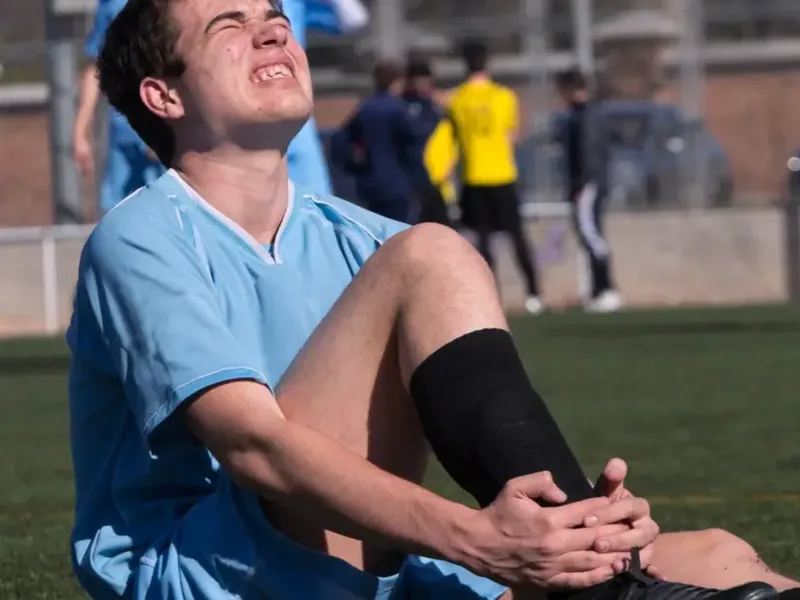
You’ve trained through worse, and you know it. That toughness is why you’re still competing. It’s also how a small tissue problem got a six-month head start.
How We Fix It
Every plan has an endpoint. Here’s what Pain, Prime, Perform and Prevent look like for a sports injury, one-on-one with a licensed physical therapist, every visit.
Weeks 1–2
Pain
Manual therapy, soft tissue work and modalities such as shockwave or laser when indicated, paired with movement the injury can tolerate right now.
Weeks 2–6
Prime
Joint mobility and graded tendon and muscle loading, plus strength at the joints above and below that handed the work over in the first place.
Weeks 6–10
Perform
Sprinting, cutting, landing, overhead work and sport-specific drills, built with a certified athletic trainer on staff who knows what your sport demands.
Weeks 10+
Prevent
Training load, technique and equipment get adjusted, the leftover side-to-side gap gets closed, and return-to-play testing decides the green light. That’s the endpoint.
5.0 average across 150+ Google reviews
Voted Best of Richardson 2026 for physical therapy
Questions, Answered
Earlier than most people assume. Once the serious swelling and inflammation have settled, which can be days or weeks depending on how bad it was, gentle rehab can begin. Starting early is how you protect joint motion and muscle activation instead of untangling stiffness later. We assess your readiness first, set the initial intensity to match it, and progress from there rather than from a calendar.
Not to get started. Texas Direct Access lets you see a licensed physical therapist for up to 30 days without a physician referral, so an injury does not have to sit around waiting on an appointment somewhere else. Treatment beyond those 30 days does require a referral, and if you are heading that way we will tell you early and help you line it up.
You will be tested, not guessed at. Feeling fine is where reinjury starts, because pain leaves before capacity comes back. The Perform and Prevent phases put you through sport-specific loading, side-to-side comparisons and the movements that hurt you in the first place, under supervision. When the testing says the tissue can handle your sport, that is your green light, and it is also the endpoint of the plan.
Book Your Visit
Request a time and a real person calls you back during business hours. No phone tree. No ‘someone will reach out.’ Just a plan.
5.0 · 150+ Google reviews
A real person calls you back
Step 1 of 5
That’s the hard part done. We’ll call during business hours to lock in your time. If you’d rather not wait for the call, the number below reaches the clinic directly.
Visit Us