1
We check that shockwave fits your injury.
Tendon pain that outlasted rest, ice, and time. Targeted acoustic waves restart the repair your body stalled on, in 15 to 20 minutes, with nothing to recover from.
What It Is
Some tendon injuries stop healing. Blood flow to the tissue drops off, calcium deposits build up, and the pain settles in as a permanent resident. Rest doesn’t solve that one, because rest is exactly what it has already had.
Shockwave therapy sends targeted acoustic waves into the tissue. They break down those calcifications, drive circulation back into the area, and trigger the repair response your body had shelved: new collagen, better blood flow, less pain signal. It treats the cause of the pain rather than covering it.
Nothing about it is invasive. No surgery, no anesthesia, no needle, no medication. A session runs 15 to 20 minutes and you walk out and go back to your day. This isn’t a novelty device: shockwave is standard equipment in sports medicine, orthopedics, and rehab, for exactly this problem. The tendon that won’t quit.
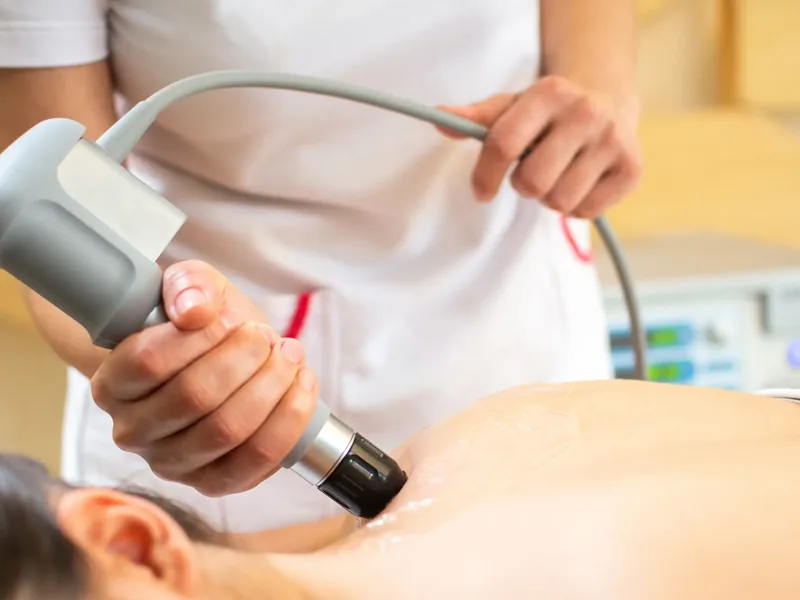 Non-invasive, and no downtime after
What It Helps
Best for the injury that stopped improving on its own months ago.
What A Session Looks Like
1
We check that shockwave fits your injury.
2
Gel on, then rapid pulses. Loud, and dialed to you.
3
You walk out and go back to your day.
Why It Works
A stalled tendon that starts healing again.
Relief without an incision or an injection.
A lunch break in, a full day after.
Less leaning on the anti-inflammatories.
Pairs Well With
Questions, Answered
It’s loud, and the noise surprises people more than the feeling does. What you feel is rapid tapping and pressure, strongest right over the sore spot. Most people tolerate it easily, and the intensity is adjustable while we work, so say the word and your therapist dials it back. No anesthesia, and nothing to recover from afterward beyond skipping high-impact exercise for a day or two.
Both use acoustic waves to restart repair, but the energy behaves differently. Standard shockwave spreads across a treatment area, which suits tendon and soft tissue trouble like plantar fasciitis, tennis and golfer’s elbow, Achilles tendinitis, rotator cuff injuries, patellar tendinitis, shin splints, frozen shoulder, and hip pain or bursitis. Focused shockwave, on our EMFOCUS system, converges its energy at a chosen depth to reach deep tendons, ligaments, and chronic pain zones. Neither one replaces the other. Your evaluation decides which your injury needs.
It depends on your plan. Shockwave is coded differently than a standard physical therapy visit, and insurers don’t all treat it the same way. We accept Medicare, Blue Cross Blue Shield, Humana, and United Healthcare. Call us and we’ll verify your specific plan before your first visit, so you know the number before you start. Call (972) 526-5693.
Book Your Visit
Request a time and a real person calls you back during business hours. No phone tree. No ‘someone will reach out.’ Just a plan.
5.0 · 150+ Google reviews
A real person calls you back
Step 1 of 5
That’s the hard part done. We’ll call during business hours to lock in your time. If you’d rather not wait for the call, the number below reaches the clinic directly.
Visit Us