Starts visit one
Pain
Get the joint out of the fire.
Manual therapy and joint mobilization take the pressure off the irritated surface and release the tight muscles pulling the joint off center.
What We Treat
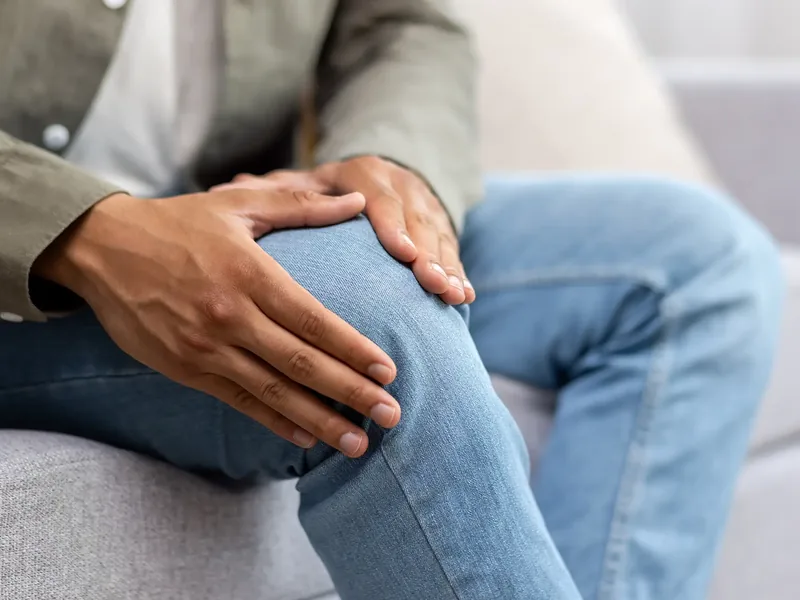
Taking the stairs one at a time. The hip that wakes you up when you roll over. Joints wear out under bad mechanics, and a cause-first evaluation finds which ones.
Sound Familiar?
Two or more? That’s a pattern, not bad luck.
Why It Happens
Your hips and knees absorb every step you take, and they handle it fine when the muscles around them share the work. When something falls out of balance, weak glutes, a tight hip, one leg carrying more than the other, the load stops spreading out and starts stacking up on one surface. Repetitive stress from running, lifting, or a job on your feet piles on top of that. Over the years, cartilage thins, bone spurs form, and motion gets restricted. And because your hip and knee share muscles and nerve supply, a stiff hip regularly shows up as knee pain, and hip pain can travel down the leg when a joint or tight muscle irritates the sciatic nerve.
Which is why treating the spot that hurts is often treating the wrong thing. A cause-first evaluation looks at strength, joint mobility, alignment, and how you actually walk, so the plan targets what is overloading the joint instead of chasing the ache around your leg.
The Honest Truth
You’ve been calling it getting older. Some of it is. The part where you plan your day around a staircase is not, and that part is treatable.
How We Fix It
You work one-on-one with a licensed physical therapist, every visit. Here’s what the four phases look like for a hip and a knee.
Starts visit one
Pain
Manual therapy and joint mobilization take the pressure off the irritated surface and release the tight muscles pulling the joint off center.
Once the pain settles
Prime
Targeted mobility work opens the hip and knee back up, because a stiff hip is one of the most common reasons a knee ends up doing more than its share.
When motion returns
Perform
Progressive strengthening for glutes, quads, and hamstrings, plus gait retraining so your walking pattern stops protecting a joint that no longer needs protecting.
Before you’re cleared
Prevent
Stairs, squats, and distance get tested before you go all in, with the warm-ups and loading strategy that keep the joint healthy. That’s the endpoint, not another appointment.
Everyone has helped with my recovery and each week we worked on different skills to obtain as much mobility as possible. The caring environment is a must for recovery and you will find that in the therapists. PT is a must for recovery and this is a perfect company to start the process.Rated 5 out of 5 stars
Shared by Mary M. · Recovery after a broken femur
Where it starts: taking the load off the joint that’s carrying it all
Where it ends: stairs, hills, and long walks without a plan for them
Questions, Answered
Usually not before you start. Arthritis and cartilage wear show up on the images of plenty of people who walk around comfortably, so a scan tells you what your joint looks like, not why it hurts on stairs. The evaluation answers the second question: strength, joint mobility, alignment, and how you move. There is one clear exception. If you had a fall and you have real swelling, instability, or you cannot put weight through it, get it looked at right away to rule out a fracture or a torn ligament.
It is the opposite, as long as the loading is right. Joints are fed by movement, and the muscle around a hip or knee is what keeps the joint from absorbing every step on its own. Sitting still is what lets that muscle fade. What does cause trouble is the wrong load in the wrong direction on a joint that is already irritated, which is exactly what your evaluation rules out before you start. You will be progressed a step at a time, one-on-one with a licensed physical therapist, every visit.
An overloaded knee and a hip you have been guarding for years are different jobs, so we will not put a number on it before we have looked at yours. What you get is a plan with an endpoint. Your joint moves through four phases, Pain, Prime, Perform, and Prevent, each with a target you have to clear, so there is never any mystery about what is left. If travel is the obstacle, our concierge mobile clinic can bring the visits to your home instead.
Book Your Visit
Request a time and a real person calls you back during business hours. No phone tree. No ‘someone will reach out.’ Just a plan.
5.0 · 150+ Google reviews
A real person calls you back
Step 1 of 5
That’s the hard part done. We’ll call during business hours to lock in your time. If you’d rather not wait for the call, the number below reaches the clinic directly.
Visit Us